I’m a Chartered Accountant. Here’s How I Actually Use Claude Cowork

Let me walk you through an audit assignment I recently worked on, where I used Claude Cowork to analyse the finance data of a growing services company.

The setup was fairly typical for a fast-growing business. Around 35 contractors across different countries, four active clients, and roughly $40,000 in monthly payouts.

The company had scaled quickly, but the finance side was still heavily manual – invoicing, validations, payment checks, everything. The founders knew something was off with the numbers, but they couldn’t pinpoint where the problem was or how much it was costing them.

I worked with a dataset that included seven interconnected tabs: vendor rosters, platform-logged hours, invoiced hours, payment records, client billing, and cost structures.

The objective was straightforward: identify the issues, quantify the financial impact, and put together a report the founders could actually use.

*(The specifics – names, numbers, and identifying details – have been changed to maintain confidentiality. The nature of the findings and the process are real.) *

Anyone who has worked in accounting knows how this kind of exercise usually goes. You open the workbook, start matching IDs across sheets, build VLOOKUPs, run reconciliation checks, create pivots, and keep moving back and forth between tabs trying to make sure nothing gets missed. It’s important work, but it’s also repetitive and mentally exhausting when the data starts getting large.

This time, I chose to approach it differently. I used Claude Cowork alongside my own review process.

A Quick Word on Claude Cowork

For those unfamiliar – it’s Anthropic’s desktop tool where Claude Cowork works directly on your files. You connect a folder (see the screenshot below), and it reads your spreadsheets, runs scripts, cross-references data, and generates outputs.

No copy-pasting into a chat window.

Think of it as a very fast analyst sitting next to you who never loses track of which tab they were on.

How the Audit Worked

I want to be clear about one thing: I didn’t just hand over the data and wait for Claude Cowork to do the work. I was running my own checks simultaneously – the way any accountant would. Roster matching, duplicate detection, hours reconciliation.

I wanted to keep my own judgment and experience as the base, and see whether Claude Cowork would arrive at similar findings.

Normally, the first pass through a dataset like this takes time. You spend a good while understanding how the tabs connect, tracing data flows, and figuring out where inconsistencies might sit.

Claude Cowork handled that part in a few minutes and immediately flagged that the vendor count in the payment ledger didn’t match the roster. I had already started noticing the same issue manually.

But here’s what surprised me. Claude Cowork didn’t just confirm my findings – it went further. It picked up things that a human eye, scanning rows one by one, would very likely miss. A lot of the findings matched mine.

But Claude Cowork also picked up things that would have been easy to miss manually.

What We Found

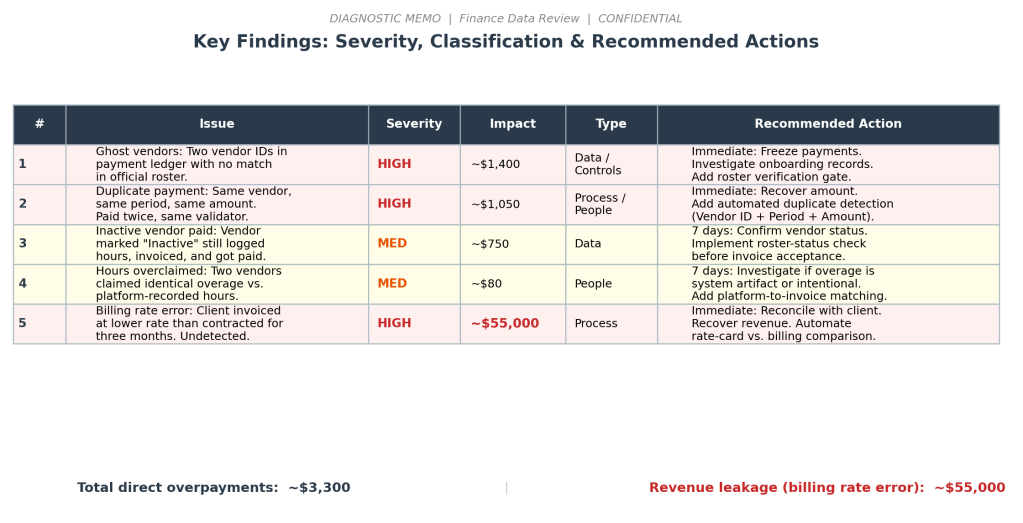
The overpayments themselves were relatively small. The bigger issue was the billing error.

For three months, one client had been invoiced at rates lower than what had actually been agreed in the contract. Nobody had caught it because nobody was consistently checking billed rates against contracted rates. That single issue alone had a revenue impact of more than $55,000!

There was also a wider mismatch between platform-tracked work and client billing, which meant the margin reporting the company relied on wasn’t fully reliable either.

The Output

The final report ranked the issues by severity, quantified the financial impact, and separated findings into data gaps, process gaps, and control failures.

Claude Cowork helped accelerate the analysis significantly, but the final decisions – what to prioritise, what to simplify, what needed attention immediately, and what could wait – came from experience.
What Claude Cowork Did Well – And What It Couldn’t Do

One thing Claude Cowork did particularly well was handling volume.

It cross-referenced all seven tabs together, checked patterns across months, and flagged anomalies quickly. For example, it identified a vendor reporting the exact same hours repeatedly over multiple months – the kind of pattern that can easily slip past someone manually reviewing spreadsheets for long periods.

In a normal workflow, catching something like that means building a separate comparison sheet, adding variance formulas and scanning for zeros. But Claude Cowork surfaced it while doing the rest of the analysis.

Where it still fell short was turning those findings into something the founders would actually sit down and read. Claude Cowork could find everything and even sort it by type, whether it was a data issue, a process gap, or a people problem.

What it couldn’t do was decide what belongs on page one and what goes in an appendix of this audit report. It kept repeating context. It buried urgent findings behind paragraphs of background.

It didn’t know that the CEO reads the first half-page and decides from there whether to keep going.

Writing for leadership is a specific skill. You need to know what matters, how much detail is enough, and how to be precise without being long.

That part – the prioritisation, structure, and judgment of what a five-minute read should contain – was where I took over.

AI is very good at finding things. The professional is essential for deciding what to say, and how

What’s Changed – And What Hasn’t

If you work in finance and the AI conversation makes you uneasy, I get it. I’ve been there. But having used it on real data, here’s what I’ve realised: AI doesn’t replace the accountant. It replaces the hours of mechanical work that usually eats up most of the accountant’s time.

This audit would have taken me two to three days the traditional way. With Claude Cowork, the heavy lifting took an afternoon.

The time I got back went into understanding root causes, assessing control gaps, and writing recommendations – the work that actually requires experience and judgment.

The tools are changing. VLOOKUPs and pivot tables served us well, and they still have their place. But for work that involves matching data across multiple large datasets, spotting patterns, and reconciling at speed – there are now better options.

The accountants and analysts who learn to use them won’t be replaced by AI. They’ll be the ones doing in an afternoon what used to take a week.

Designing an Invoicing SOP for a Growing Startup

In my previous article, I discussed why SOPs become important as businesses grow. In this article, I want to share how I structured the invoicing process in an IT services company that was moving from manual operations towards automation.

Since it was a startup, the team was initially small, volumes were manageable, and coordination was mostly informal. Invoicing was therefore handled manually. However, as the business expanded – with more clients, more consultants, and increasing billing variations – the same system began causing delays and confusion.

At the same time, automation was being planned, and inputs were being gathered from the operations team to build a customized internal system on Remote Desktop. For that to work effectively, the invoicing process first had to be clearly mapped and documented.

So, I mapped the invoicing process exactly as it functioned in the company and formalized it step by step.

Invoicing Process Workflow (SOP Structure)

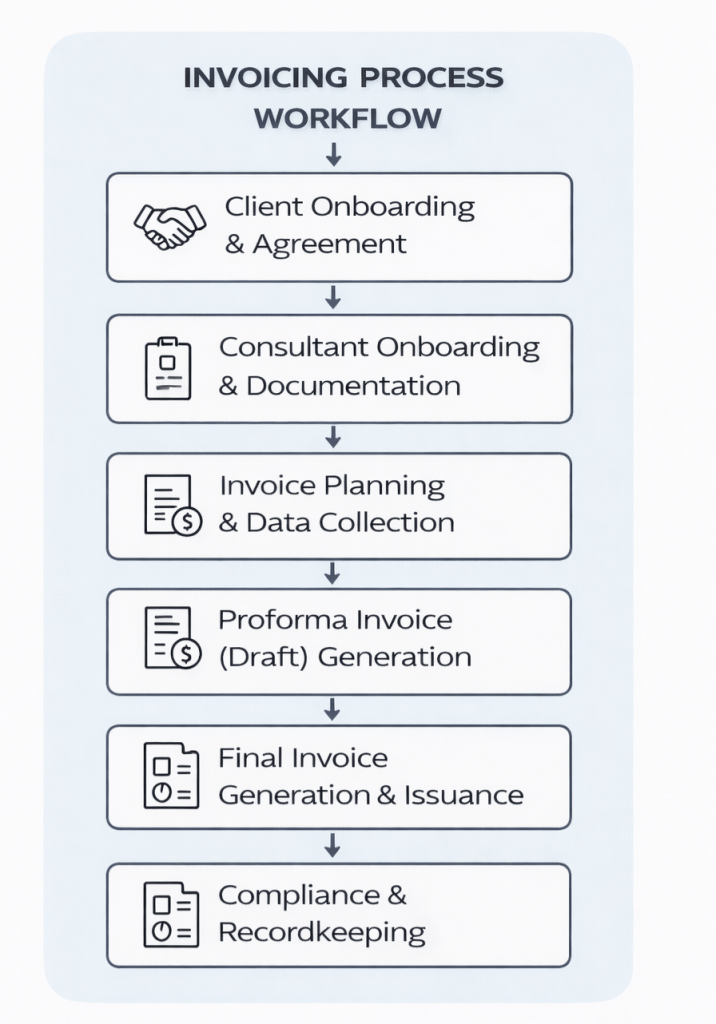
The flowchart below outlines how the invoicing workflow was designed to cover the entire process – from onboarding to compliance – rather than focusing only on invoice preparation.

The detailed steps for each stage are described below.

1. Client Onboarding & Agreement

Objective: Ensure billing terms and statutory details are defined before invoicing begins.

  • Sign a formal agreement (MSA/SOW) with clearly defined billing terms
  • Creation of client master in internal system (GST, PAN, address, tax configuration)
  • Storage of agreement and statutory data in designated shared folder

2. Consultant Onboarding & Documentation

Objective: Ensure complete documentation before activation for billing.

  • Collection of identity and statutory documents (PAN, Aadhaar, GST if applicable)
  • Bank account details for payments
  • Signed agreement / offer letter
  • Creation of consultant master in internal records
  • Mandatory completion before billing eligibility

Updated upon onboarding of each new consultant

3. Monthly Invoice Planning & Data Collection

Objective: Validate billing inputs before invoice preparation.

  • Monthly billing cycle initiated
  • Client-side inputs:
    • PO / SOW confirmation
    • Rate card validation (regular & overtime)
    • Applicable GST structure
    • Withholding tax (TDS) and other agreed deductions
  • Consultant-side inputs:
    • Approved timesheets
    • Overtime approvals
    • Reimbursement documentation
  • Consolidation of all inputs before defined monthly cut-off (e.g., 5th)
  • Maintenance of issuance and tracking logs

4. Proforma Invoice (Draft) Generation

Objective: Reduce errors before final invoice issuance.

  • Generation of draft invoice using standard template
  • Validation of billing period, service description, and tax computation
  • Attachment of supporting documents
  • Client review and approval before finalisation

5. Final Invoice Generation & Issuance

Objective: Formal invoice issuance and tracking.

  • Final invoice generated post approval
  • Internal review where required
  • Dispatch via email or client billing portal
  • Logging of dispatch date, due date, and contact details

6. Payment Tracking & Follow-up

Objective: Ensure timely collection and reconciliation.

  • Monitoring of agreed payment terms
  • Follow-up reminders for overdue invoices
  • Reconciliation of receipts

Updating of tracking system

7. Compliance & Recordkeeping

Objective: Maintain audit-ready documentation.

  • Archival of invoices and supporting documents in structured cloud folders
  • Maintenance of GST records and invoice registers
  • Submission of statutory documents (ESI, EPF, etc.) where required
  • Sharing of required payroll/compliance documentation with client

One key principle followed throughout was: Invoicing begins at onboarding, not at billing.

Standardizing the Folder Structure

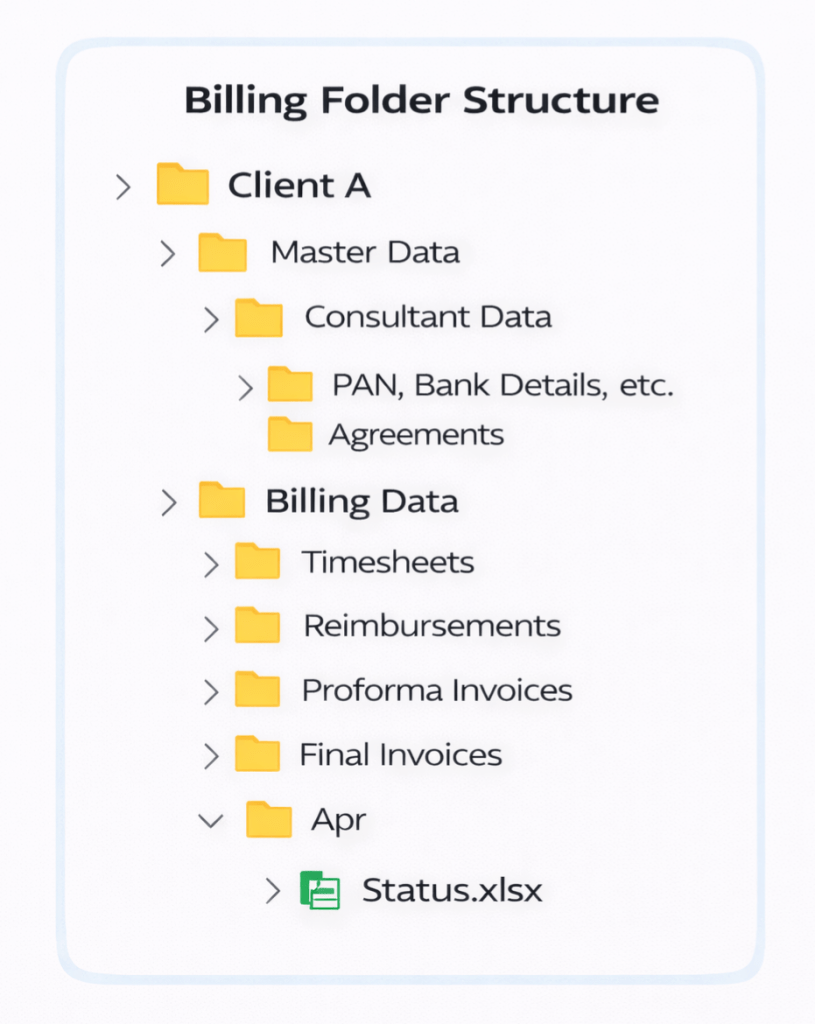
Along with defining the process flow, it was equally important to standardize how documents were stored. A folder structure was created so that every input had a clear place for storage and reference.

The folder hierarchy broadly covered:

  • Client Master Data
  • Consultant Documentation
  • Billing Data (Timesheets, Reimbursements, Proforma, Final Invoices)
  • Month-wise status tracking

This created a central reference point for finance, HR, and founders, making it easier to manage billing, consultant payments, TDS and compliance requirements, audits, and overall coordination.

Why This Structure Was Important

This workflow was built around how the company actually operated. Every business will have its own variations, and the process should reflect that reality. The reason I am sharing this example is not to suggest that one structure fits all, but to highlight how important it is to define processes clearly before attempting automation.

In this case, once the invoicing flow was properly structured, building the system became much simpler because the software could follow a clearly defined process instead of informal practices.

A Key Takeaway

This experience reinforced for me that strong processes make automation meaningful. When the process is clear, automation brings consistency, reduces dependency on individuals, and improves control over revenue and cash flow.

In finance, that clarity translates into discipline – more predictable billing, better compliance, smoother coordination, and clearer financial visibility as the business grows.

Why Finance Teams Struggle Without SOPs

SOPs, or Standard Operating Procedures, are written guidelines for carrying out routine work so that tasks are handled consistently, regardless of who is doing them.

In very small businesses, SOPs often feel unnecessary because the volume of work is manageable, teams are small, and everyone works in close coordination. Founders are usually involved in most decisions, and many things get done through informal discussions and shared understanding.

The challenge begins as the business grows. Teams expand, new hires join, responsibilities get distributed, and founders can no longer stay involved in every detail. What earlier worked through informal coordination starts breaking down, and finance teams begin to struggle. Tasks still get done, but not smoothly. Follow-ups are missed, numbers don’t always match, and routine work starts taking longer than it should because too much depends on individuals rather than clear processes.

Finance teams usually feel this strain first because finance sits at the centre of operations. Invoicing, collections, payroll, payments, compliance, and reporting are all interconnected, and even a small gap in one area quickly affects another.

A simple example from finance operations

Let me share a simple example from practice:

A delay in raising an invoice often leads to delayed collections. That delay in invoicing usually happens because the required inputs are not received on time, or because responsibility for follow-ups is not clearly defined.

In the absence of a clear SOP, teams are often unsure about the exact steps involved or who owns each part of the process. The issue is not about individual capability or effort, but about the lack of documented instruction and ownership.

Delayed collections then affect cash flow, which can have a significant impact on a growing business.

This is usually the point where businesses realise that informal coordination is no longer enough. Clear SOPs become a necessary and often non-negotiable part of running day-to-day finance operations smoothly.

Why experience alone doesn’t solve this

Faced with these delays and inconsistencies, many businesses assume that the solution is to hire more experienced people. While experience helps professionals handle problems when they arise, it doesn’t prevent the same issues from repeating as volumes grow and more people get involved.

Without clear SOPs, common issues start showing up:

  • Two people handle the same task differently
  • Important checks get skipped during busy periods
  • New team members take longer to settle in because expectations aren’t clearly defined

Over time, this inconsistency creates confusion and duplication of work – even in teams that are otherwise capable and hardworking.

What SOPs actually do in day-to-day finance work

SOPs are often misunderstood as long documents created only for audits or compliance. In reality, effective SOPs are simple working guides.

They answer practical questions like:

  • When does this activity start?
  • What information is needed before beginning?
  • Who prepares the work, who reviews it, and who approves it?
  • What checks are critical?
  • What should happen if something doesn’t look right?

In practice, this could mean something as simple as defining who collects billing inputs, by when, and in what format; or clearly laying down when payroll data is frozen and who signs off exceptions. These small clarities remove a surprising amount of day-to-day confusion.

Why SOPs matter even more in remote and growing teams

When teams work remotely or in delivery-driven setups, people are not sitting together at the same location. Operations are largely cloud-based, and communication happens through emails, messages, or scheduled calls, which means small gaps may not be immediately noticed.

Without clear structure and documented steps, work can easily stall or move inconsistently. For example, the invoicing team may be waiting for inputs from another team, or payroll processing may be blocked due to missing approvals.

In such scenarios, SOPs act as a shared reference point that everyone can rely on. They allow work to move forward without constant follow-ups, make handovers smoother, and reduce dependency on specific individuals. They also make onboarding easier, because new team members know what is expected from the start.

Moving from firefighting to reliability

In my practical experience, I have often seen finance professionals take pride in being able to “manage somehow” when things get difficult. Being calm under pressure and fixing issues as they come up are valuable skills. However, relying only on individual firefighting over time becomes exhausting and risky.

SOPs help ease this burden. When processes are clearly defined and documented, work continues smoothly even when people are busy, unavailable, or change roles.

In the long run, strong finance operations are not about how much one person can handle. They are about how consistently the work gets done, month after month, as the business grows.

What comes next

This article focuses on why SOPs matter as businesses scale. In another article, I plan to share how an SOP was set up for invoicing in practice, and the difference it made.

Repatriation from India Explained: NRE vs NRO Accounts

Repatriation of funds from India is one of those things that seems obvious until you actually try doing it.

The assumption is simple – it’s your money, so moving it abroad shouldn’t raise questions.

In practice, however, repatriation is not just a banking step; it sits at the intersection of FEMA regulations and tax compliance. That’s where confusion usually begins.

Before getting into paperwork or forms, one basic question that needs to be answered is this: where is the money held?
In most cases, everything depends on whether the funds sit in an NRE account or an NRO account.

What does “repatriation” really mean?

Repatriation simply means moving money from India to a foreign country, to the account of a non-resident.

This could involve:

  • Transferring money from an Indian account to an overseas bank account
  • Moving funds from an NRO account to an NRE account
  • Remitting sale proceeds of property, shares, or mutual funds
  • Sending rental income, interest, or dividends earned in India abroad

Although these transactions may all look like ordinary transfers, they are not treated the same under Indian regulations.

NRE vs NRO – the difference that matters

An NRE (Non-Resident External) account typically holds money earned outside India and remitted into the country. Since the source of funds is foreign, both the principal and interest are fully repatriable, and there is no RBI cap on transferring these funds abroad. Subject to routine KYC and bank checks, repatriation from an NRE account is usually smooth.

An NRO (Non-Resident Ordinary) account, on the other hand, holds Indian-source income — such as rent from property in India, sale proceeds of Indian assets, or dividends and interest received locally. Because this income arises in India, repatriation is restricted and subject to tax clearance and FEMA compliance. The RBI permits repatriation of up to USD 1 million per financial year, provided the required documentation is in place.

This difference is the single biggest reason repatriation feels easy in some cases and complicated in others.

Why repatriation from NRO accounts gets complicated

Funds in an NRO account represent income or gains earned in India. Before such money is sent abroad, Indian law requires confirmation that applicable taxes have been paid and that the remittance complies with FEMA rules.

Banks aren’t tax officers, but they can’t ignore tax either. As authorised dealers, they are expected to check that tax and regulatory requirements are in order before processing a remittance. That is why repatriation from NRO accounts almost always leads to questions and documentation requests.

When repatriation is relatively simple – and when it needs planning Repatriation is generally smoother when funds are held in an NRE account, the amounts involved are small, or the tax position is already clear and well documented. This does not mean tax is irrelevant – only that the process tends to be lighter.

Planning becomes essential when funds sit in an NRO account, the amount is significant, or the money represents sale proceeds, capital gains, or accumulated income. In such cases, repatriation is perfectly permitted, but only after tax and regulatory checks are completed.

In Summary

If you’re planning to repatriate funds, start by asking two questions: where did this money come from, and which account is it sitting in today?
Most of the confusion around repatriation clears up once those answers are clear.

What usually comes next

Once it’s clear whether funds are held in an NRE or NRO account, the next question is almost always about documentation – particularly Forms 15CA and 15CB. That paperwork, and why banks insist on it, is where most people get stuck. I’ve covered that separately in another article.

Accounting Treatment of Mutual Fund Investments in Company Books

(And How Companies Should Deal with NAV Changes)

I was once asked a question in an interview that seemed straightforward at first, yet pointed to a practical issue that comes up often in corporate accounting.

“How should mutual fund investments be accounted for in company books? And what do we do with daily NAV changes?”


On the surface, this sounds simple. In practice, however, companies often end up with inconsistent or incorrect accounting, particularly when NAVs fluctuate on a daily basis.

This note explains the correct and commonly accepted accounting treatment, based on accounting standards and real-world practice.

How Mutual Fund Investments Are Classified

In company books, mutual fund investments are generally classified as financial assets. The exact classification depends on several factors, including:

  • Intent of holding (short-term vs long-term)
  • Type of mutual fund (debt vs equity)
  • Applicable accounting framework (Ind AS vs non- Ind AS)

Most operating companies invest surplus funds in either liquid funds, debt funds or short duration / over-night funds. These are typically treated as current investments.

Which accounting standard applies?

Companies do not choose their accounting framework – it is determined by law.

Indian companies to which Ind AS applies must follow Ind AS 109 – Financial Instruments. Other Indian companies continue to follow AS 13 – Accounting for Investments.

Foreign parent companies may prepare their global financial statements under IFRS or US GAAP, but Indian entities are required to follow Indian accounting standards, based on applicability.

Initial accounting treatment – at the time of investment

When a company invests in mutual funds, the accounting entry is straightforward:

Investment in Mutual Fund – Debit
    To Bank A/c

The investment is recorded at cost and reflected under “Investments” in the balance sheet, usually as a current investment. At this stage, there is no income or gain – it is simply the deployment of surplus funds.

How should NAV changes be treated?

This is where most practical questions arise, largely because the treatment of NAV changes depends on the accounting framework the company follows. Broadly, there are two approaches, each driven by the applicable accounting standard.

Accounting treatment under AS 13 (Indian GAAP)

Under AS 13, mutual fund investments are valued at the lower of cost or fair value (NAV) at the reporting date.

In practice:

  • If NAV is lower than cost at year end, the loss is recognised in the books
  • If NAV is higher than cost, the gain is not recognised (conservative approach is followed)

Daily NAV fluctuations are not recorded and valuation is done only at reporting dates such as month-end or year-end.

Accounting treatment under Ind AS 109

Under Ind AS 109, mutual fund investments are treated as financial assets where such investments are classified as fair value through profit or loss (FVPL):

  • The investment is carried at fair value (NAV)
  • Both unrealised gains and unrealised losses are recognised in the profit and loss account

In this case, NAV changes are not merely tracked – they are accounted for as part of financial reporting.

When is profit actually realized?

Irrespective of the accounting framework, final profit or loss is realised only on redemption of mutual fund units.

At the time of redemption:

  • Sale proceeds are compared with the carrying value in the books
  • The difference is recognised as profit or loss
  • Any earlier NAV adjustments naturally reverse or settle

A note on accounting policy and consistency

One point here is critical and often overlooked. Companies need to clearly define their accounting policy for mutual fund investments and apply it consistently year after year. Changing the treatment based on short-term market movements only creates confusion and weakens the credibility of the financials.

Closing thought

The accounting treatment of mutual fund investments in company books is not complex.
What creates confusion is assuming that every NAV movement requires an accounting entry. While NAV tracking can be useful for internal monitoring, accounting should always follow the applicable standard – and once an approach is adopted, it should be applied consistently.

Weekly Cash Flow: The One Report Business Owners Actually Need

Most business owners review their financials once a month, usually through monthly reports and profit numbers. By the time these are discussed, any cash issue has already been felt and managed in the moment.

I was reminded of this clearly while working with a business owner who tracked his numbers very closely. Every month, profits looked fine. Sales were growing, costs were under control, and on paper the business was doing well.

Yet, almost every month, there was stress around payments.

When salaries or large vendor bills were due, cash felt tight. Payments had to be staggered and follow-ups rushed.

His question was simple and genuine:

“If the business is profitable, why does cash always feel like a problem?”

The issue wasn’t effort or attention. What was missing was weekly visibility into cash.
Once we started looking at cash week by week, the pattern became clear. The pressure wasn’t sudden – it was building up quietly during the month.

What Weekly Cash Flow Actually Means

When people hear the term weekly cash flow, they often assume it’s some complex report.

It isn’t.

A weekly cash flow report is a simple way to track cash coming in and going out over the next few weeks. It shows what cash is expected and compares it with what actually happens.

In simple terms, it answers this question:

Do we have enough cash to comfortably meet our payments over the next few weeks?

What Goes into a Weekly Cash Flow View

At its most basic, a weekly cash flow view tracks expected cash movement for the week and compares it with what actually happens.

It brings together:

  • cash available at the start of the week
  • expected customer collections
  • expected payments
  • actual cash received and paid
  • and the variance between expectation and reality

How Businesses Actually Use This

Once this kind of report is reviewed every week, patterns start becoming visible.

Payment delays start standing out. Certain weeks consistently show heavier cash outflows. Some expenses hit earlier than expected, and items assumed to be “one-time” begin to repeat.

These patterns rarely show up clearly in monthly reports. They become obvious only when cash is looked at week by week.

A Simple Illustration

Let’s say this is what was expected for a particular week:

  • Customer collections expected: ₹1 crore
  • Payments expected: ₹60 lakh

Based on this, the week looked comfortable.

What actually happened:

  • ₹70 lakh was received from customers
  • ₹65 lakh was paid due to an unplanned vendor payment

The profit number didn’t change. But the cash position did.

Why This Helps Business Owners

Instead of reacting at the last moment, they can see in advance:

  • which payments need follow-up
  • whether any expense can be deferred
  • whether upcoming commitments are fully covered
  • whether the next few weeks look tight or manageable

What Helps in Practice

From what I’ve seen, cash flow dashboards are useful, especially for MIS and overall visibility. Management does use them to get a broad picture.

But when it comes to day-to-day decision-making, a simple Excel sheet, updated once a
week and reviewed consistently, is often what actually gets used.

More than the format of the report, what really matters is the habit of reviewing cash regularly and acting on what it shows. Businesses that do this don’t eliminate surprises, but they reduce how often those surprises turn into stress.

Why Profitable Companies Still Run Out of Cash

I’ve often seen founders confused by one situation in particular.

The business is doing well.

Revenue is growing.

The profit number looks healthy.

And yet, cash always feels tight.

This usually comes as a surprise. On paper, everything looks fine, but the bank balance tells a different story. The reason is simple: profit and cash flow are not the same thing.

Profit and Cash Are Not the Same Thing

Profit is an accounting outcome. It is calculated on an accrual basis – revenue and expenses are recorded when they are earned or incurred, not when cash actually moves.

Cash is far more straightforward. It is the money actually sitting in the bank.

A business can look profitable even though the money hasn’t actually come in yet. This gap becomes more noticeable as the business grows and day-to-day operations increase.

Delayed Customer Payments Are the Biggest Cash Issue

In most cases, cash flow problems have nothing to do with losses. They happen because of timing.

Revenue gets recorded when an invoice is raised, but cash comes in only when the
customer actually pays.

Let me explain this with a simple example.

  • An invoice of ₹50 lakh is raised to Client A in April.
  • The payment terms are 60 days.
  • April’s P&L shows revenue of ₹50 lakh.
  • But no cash is received in April.

So, from an accounting point of view, April looks like a good month. But from a cash point of view, nothing has come in yet.

At the same time, salaries have to be paid, vendors need to be cleared, rent goes out, and statutory payments fall due in April. This gap between money going out and money coming in is where cash pressure quietly starts building.

Advance and Prepaid Expenses Reduce Cash Immediately

Another common reason for cash pressure is advance or prepaid expenses.

Businesses often pay upfront for software subscriptions, conferences, marketing tools, or annual services. When these payments are made, cash goes out immediately, even though the expense is spread over several months in the books.

Example

  • An annual software subscription of ₹12 lakh is paid in April
  • Only ₹1 lakh is charged as an expense in April’s P&L

So, while the profit impact for April is just ₹1 lakh, the bank balance reduces by the full ₹12 lakh in the same month.

This is where confusion usually sets in, especially when founders rely only on profit numbers to judge performance.

Growth Itself Can Put Pressure on Cash Flow

Growth is usually seen as a good thing, but it often puts pressure on cash.

As businesses grow, they start hiring more people, working with more vendors, and
spending more on sales and delivery. These costs usually go out immediately, while
collections take time.

Because of this, even a profitable and growing business can feel constant cash pressure if the timing of money coming in and going out is not managed carefully.

What Helps in Practice

From what I’ve seen, the solution is usually not complex models or fancy dashboards.

What really helps is basic discipline and regular visibility into cash.

A simple weekly cash flow view can make a big difference. Something that clearly shows:

  • what customer payments are expected
  • what payments need to be made
  • what cash actually moved during the week
  • and what caused the variance (the difference between what we expected and what
  • actually happened)

Along with this, having clear visibility on receivables and thinking about the cash impact before committing to new spends helps avoid most surprises.

Key Points to Remember

  • Profit does not mean cash is sitting in the bank.
  • Most cash problems come from timing, not from losses.
  • Upfront payments and delayed collections slowly reduce cash.
  • Regular visibility into cash flow helps prevent surprises.