
Designing an Invoicing SOP for a Growing Startup

In my previous article, I discussed why SOPs become important as businesses grow. In this article, I want to share how I structured the invoicing process in an IT services company that was moving from manual operations towards automation.

Since it was a startup, the team was initially small, volumes were manageable, and coordination was mostly informal. Invoicing was therefore handled manually. However, as the business expanded – with more clients, more consultants, and increasing billing variations – the same system began causing delays and confusion.

At the same time, automation was being planned, and inputs were being gathered from the operations team to build a customized internal system on Remote Desktop. For that to work effectively, the invoicing process first had to be clearly mapped and documented.

So, I mapped the invoicing process exactly as it functioned in the company and formalized it step by step.

Invoicing Process Workflow (SOP Structure)

The flowchart below outlines how the invoicing workflow was designed to cover the entire process – from onboarding to compliance – rather than focusing only on invoice preparation.
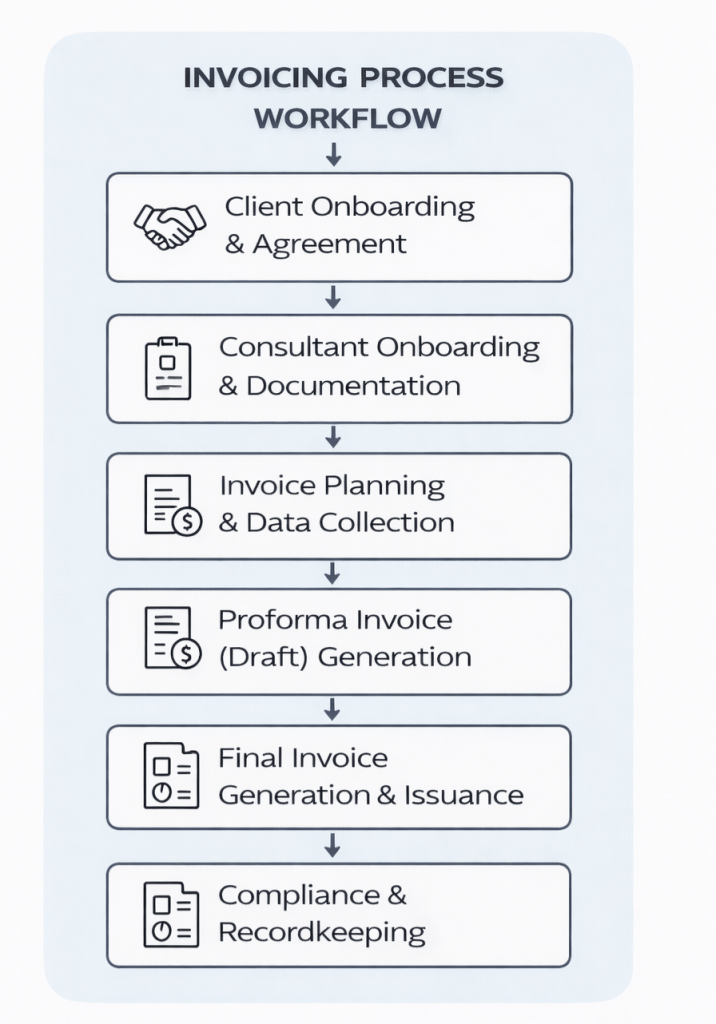
The detailed steps for each stage are described below.

1. Client Onboarding & Agreement

Objective: Ensure billing terms and statutory details are defined before invoicing begins.

  • Sign a formal agreement (MSA/SOW) with clearly defined billing terms
  • Creation of client master in internal system (GST, PAN, address, tax configuration)
  • Storage of agreement and statutory data in designated shared folder

2. Consultant Onboarding & Documentation

Objective: Ensure complete documentation before activation for billing.

  • Collection of identity and statutory documents (PAN, Aadhaar, GST if applicable)
  • Bank account details for payments
  • Signed agreement / offer letter
  • Creation of consultant master in internal records
  • Mandatory completion before billing eligibility

Updated upon onboarding of each new consultant

3. Monthly Invoice Planning & Data Collection

Objective: Validate billing inputs before invoice preparation.

  • Monthly billing cycle initiated
  • Client-side inputs:
    • PO / SOW confirmation
    • Rate card validation (regular & overtime)
    • Applicable GST structure
    • Withholding tax (TDS) and other agreed deductions
  • Consultant-side inputs:
    • Approved timesheets
    • Overtime approvals
    • Reimbursement documentation
  • Consolidation of all inputs before defined monthly cut-off (e.g., 5th)
  • Maintenance of issuance and tracking logs

4. Proforma Invoice (Draft) Generation

Objective: Reduce errors before final invoice issuance.

  • Generation of draft invoice using standard template
  • Validation of billing period, service description, and tax computation
  • Attachment of supporting documents
  • Client review and approval before finalisation

5. Final Invoice Generation & Issuance

Objective: Formal invoice issuance and tracking.

  • Final invoice generated post approval
  • Internal review where required
  • Dispatch via email or client billing portal
  • Logging of dispatch date, due date, and contact details

6. Payment Tracking & Follow-up

Objective: Ensure timely collection and reconciliation.

  • Monitoring of agreed payment terms
  • Follow-up reminders for overdue invoices
  • Reconciliation of receipts

Updating of tracking system

7. Compliance & Recordkeeping

Objective: Maintain audit-ready documentation.

  • Archival of invoices and supporting documents in structured cloud folders
  • Maintenance of GST records and invoice registers
  • Submission of statutory documents (ESI, EPF, etc.) where required
  • Sharing of required payroll/compliance documentation with client

One key principle followed throughout was: Invoicing begins at onboarding, not at billing.

Standardizing the Folder Structure

Along with defining the process flow, it was equally important to standardize how documents were stored. A folder structure was created so that every input had a clear place for storage and reference.
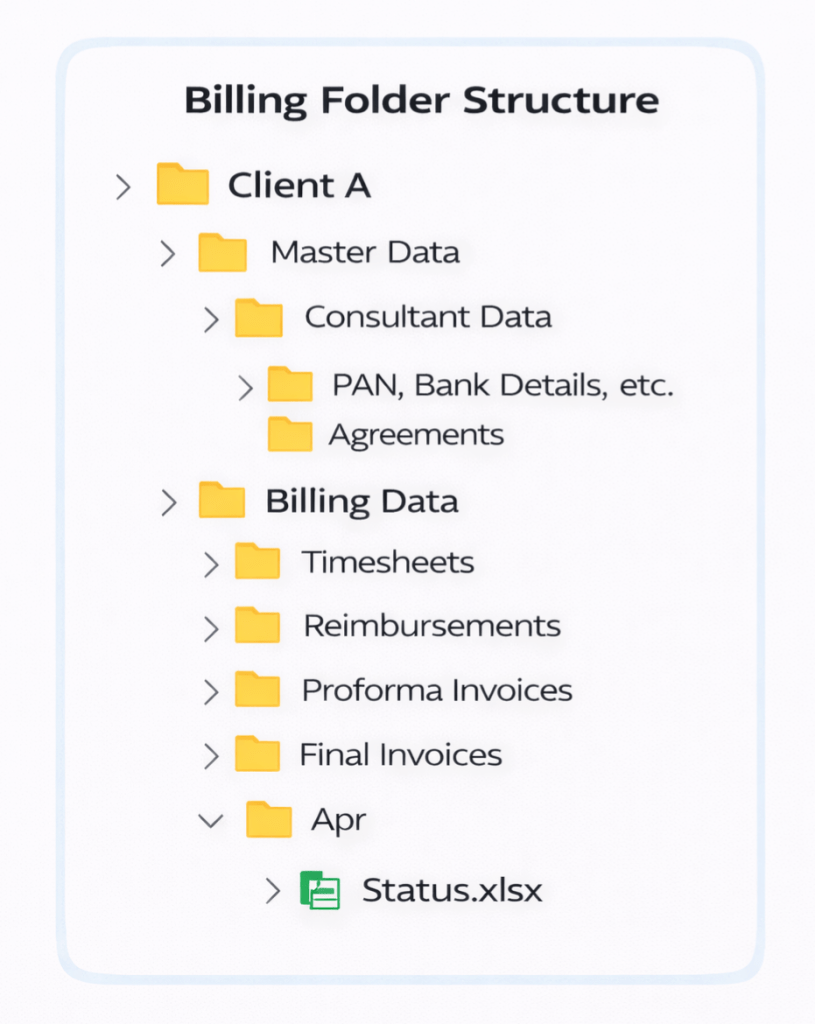
The folder hierarchy broadly covered:

  • Client Master Data
  • Consultant Documentation
  • Billing Data (Timesheets, Reimbursements, Proforma, Final Invoices)
  • Month-wise status tracking

This created a central reference point for finance, HR, and founders, making it easier to manage billing, consultant payments, TDS and compliance requirements, audits, and overall coordination.

Why This Structure Was Important

This workflow was built around how the company actually operated. Every business will have its own variations, and the process should reflect that reality. The reason I am sharing this example is not to suggest that one structure fits all, but to highlight how important it is to define processes clearly before attempting automation.

In this case, once the invoicing flow was properly structured, building the system became much simpler because the software could follow a clearly defined process instead of informal practices.

A Key Takeaway

This experience reinforced for me that strong processes make automation meaningful. When the process is clear, automation brings consistency, reduces dependency on individuals, and improves control over revenue and cash flow.

In finance, that clarity translates into discipline – more predictable billing, better compliance, smoother coordination, and clearer financial visibility as the business grows.

Why Finance Teams Struggle Without SOPs

SOPs, or Standard Operating Procedures, are written guidelines for carrying out routine work so that tasks are handled consistently, regardless of who is doing them.

In very small businesses, SOPs often feel unnecessary because the volume of work is manageable, teams are small, and everyone works in close coordination. Founders are usually involved in most decisions, and many things get done through informal discussions and shared understanding.

The challenge begins as the business grows. Teams expand, new hires join, responsibilities get distributed, and founders can no longer stay involved in every detail. What earlier worked through informal coordination starts breaking down, and finance teams begin to struggle. Tasks still get done, but not smoothly. Follow-ups are missed, numbers don’t always match, and routine work starts taking longer than it should because too much depends on individuals rather than clear processes.

Finance teams usually feel this strain first because finance sits at the centre of operations. Invoicing, collections, payroll, payments, compliance, and reporting are all interconnected, and even a small gap in one area quickly affects another.

A simple example from finance operations

Let me share a simple example from practice:

A delay in raising an invoice often leads to delayed collections. That delay in invoicing usually happens because the required inputs are not received on time, or because responsibility for follow-ups is not clearly defined.

In the absence of a clear SOP, teams are often unsure about the exact steps involved or who owns each part of the process. The issue is not about individual capability or effort, but about the lack of documented instruction and ownership.

Delayed collections then affect cash flow, which can have a significant impact on a growing business.

This is usually the point where businesses realise that informal coordination is no longer enough. Clear SOPs become a necessary and often non-negotiable part of running day-to-day finance operations smoothly.

Why experience alone doesn’t solve this

Faced with these delays and inconsistencies, many businesses assume that the solution is to hire more experienced people. While experience helps professionals handle problems when they arise, it doesn’t prevent the same issues from repeating as volumes grow and more people get involved.

Without clear SOPs, common issues start showing up:

  • Two people handle the same task differently
  • Important checks get skipped during busy periods
  • New team members take longer to settle in because expectations aren’t clearly defined

Over time, this inconsistency creates confusion and duplication of work – even in teams that are otherwise capable and hardworking.

What SOPs actually do in day-to-day finance work

SOPs are often misunderstood as long documents created only for audits or compliance. In reality, effective SOPs are simple working guides.

They answer practical questions like:

  • When does this activity start?
  • What information is needed before beginning?
  • Who prepares the work, who reviews it, and who approves it?
  • What checks are critical?
  • What should happen if something doesn’t look right?

In practice, this could mean something as simple as defining who collects billing inputs, by when, and in what format; or clearly laying down when payroll data is frozen and who signs off exceptions. These small clarities remove a surprising amount of day-to-day confusion.

Why SOPs matter even more in remote and growing teams

When teams work remotely or in delivery-driven setups, people are not sitting together at the same location. Operations are largely cloud-based, and communication happens through emails, messages, or scheduled calls, which means small gaps may not be immediately noticed.

Without clear structure and documented steps, work can easily stall or move inconsistently. For example, the invoicing team may be waiting for inputs from another team, or payroll processing may be blocked due to missing approvals.

In such scenarios, SOPs act as a shared reference point that everyone can rely on. They allow work to move forward without constant follow-ups, make handovers smoother, and reduce dependency on specific individuals. They also make onboarding easier, because new team members know what is expected from the start.

Moving from firefighting to reliability

In my practical experience, I have often seen finance professionals take pride in being able to “manage somehow” when things get difficult. Being calm under pressure and fixing issues as they come up are valuable skills. However, relying only on individual firefighting over time becomes exhausting and risky.

SOPs help ease this burden. When processes are clearly defined and documented, work continues smoothly even when people are busy, unavailable, or change roles.

In the long run, strong finance operations are not about how much one person can handle. They are about how consistently the work gets done, month after month, as the business grows.

What comes next

This article focuses on why SOPs matter as businesses scale. In another article, I plan to share how an SOP was set up for invoicing in practice, and the difference it made.